
Plan tax strategies for UK and Australian entities
A practical playbook for structuring, incentivising, and timing tax obligations across UK and Australian entities—reducing double taxation, freeing cash flow, and aligning structures with commercial goals.
Milton Brooks
11/6/20243 min read
“Tax planning is the art of arranging affairs so that tax liabilities are minimised within the law.”
— Adapted from Lord Clyde, UK House of Lords (1929)
Disclaimer
This blog provides general information only and should not replace qualified tax, legal, or accounting advice. Always consult a registered tax agent in your jurisdiction. UK and Australian tax systems are subject to frequent changes—verify current rates, reliefs, and compliance obligations before acting.
Introduction
Operating across UK and Australian entities creates opportunities—but also complexities—in tax strategy.
Well‑structured planning can:
Optimise after‑tax profits through lawful incentives and reliefs
Reduce exposure to double taxation
Improve cash flow predictability via timing strategies
Align group structures with long‑term commercial goals
Whether you’re a Perth‑based enterprise with a UK subsidiary, or a UK‑headquartered business expanding into Australia, deliberate coordination between jurisdictions protects value and avoids costly surprises.
Strategy 1: Structure for efficiency and compliance
Entity selection: Choose between company, branch, or partnership structures based on liability, reporting, and tax profile in each country.
Permanent establishment (PE): Understand what creates a PE under the UK‑Australia Double Taxation Agreement (DTA) to manage tax residency risks.
Group structuring: Consider intermediate holding companies in treaty‑friendly jurisdictions only if commercially justified and compliant with anti‑avoidance rules.
Transfer pricing: Set intercompany charges at arm’s length, documented per OECD and local requirements.
Withholding taxes: Map dividend, interest, and royalty flows to confirm treaty rates; ensure forms and residency certificates are in place.
Controlled foreign company (CFC) rules: Assess if profits of offshore entities can be attributed back to the parent jurisdiction for tax.
Strategy 2: Leverage jurisdiction‑specific incentives
UK incentives:
R&D Tax Relief (SME or RDEC regimes)
Patent Box (10% rate on qualifying IP profits)
Annual Investment Allowance (AIA) for plant/machinery
Reliefs for share schemes (EMI, CSOP) to reward and retain talent
Australian incentives:
R&D Tax Incentive (refundable and non‑refundable offsets)
Instant Asset Write‑Off and Temporary Full Expensing (check current thresholds)
Small business income tax concessions
Export Market Development Grants (EMDG) for eligible promotion expenses
Cross‑border alignment: Avoid double‑claiming the same expenditure; coordinate R&D claims to meet each jurisdiction’s definitions and record‑keeping.
Strategy 3: Manage timing and cash flow
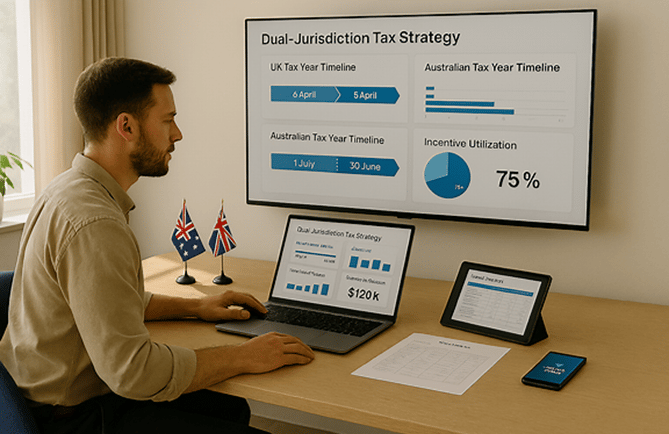
Tax year differences: UK tax year runs 6 April–5 April; Australia’s is 1 July–30 June. Align accounting periods where possible or plan for staggered obligations.
Prepayment and deferral: Bring forward deductible expenses or defer income to smooth taxable profits—ensuring this aligns with commercial reality.
Dividend planning: Consider franking (Australia) and dividend allowances (UK); optimise timing to utilise shareholders’ tax‑free thresholds.
Foreign tax credits (FTCs): Claim FTCs under the DTA to avoid double taxation, matching income and credit recognition across both jurisdictions.
GST vs VAT: Manage registration thresholds, reclaim processes, and timing for payments/refunds to protect cash flow.
Implementation checklist
Confirm entity types, residency status, and PE exposure
Map intercompany transactions and ensure transfer pricing compliance
Identify and calendar tax year‑end dates for each jurisdiction
Register and maintain eligibility for relevant incentives
Build a tax calendar incorporating payment dates, lodgement deadlines, and DTA claims
Next steps
This week: Review entity structures and cross‑border transactions for compliance with the UK‑Australia DTA.
Within 14 days: Engage local advisors in both jurisdictions to scope incentive eligibility and transfer pricing documentation.
Within 30 days: Implement a coordinated tax calendar and cross‑border cash flow plan, integrating GST/VAT and withholding tax timelines.
Useful AI prompts
“Outline the steps to claim the UK Patent Box relief for a tech company with Australian R&D operations.”
“Compare eligibility and benefit differences between UK R&D Tax Relief and Australia’s R&D Tax Incentive.”
“Draft a cross‑border dividend payment schedule optimised for UK dividend allowance and Australian franking credits.”
“Generate a tax calendar for UK and Australian obligations based on these entity year‑ends.”
“Explain how the UK‑Australia DTA allocates taxing rights on royalties and interest.”
About Mission Command Business
Mission Command Business equips small enterprises with strategic frameworks and operational tools. From financial management and business direction & support, to people & workplace management, and systems & processes, we help you unlock sustainable growth and lasting impact.