
Optimise inventory management to free up capital
A structured approach to inventory optimisation, blending demand alignment, visibility improvements, and capital release tactics to strengthen cash flow and operational agility.
Milton Brooks
10/23/20243 min read
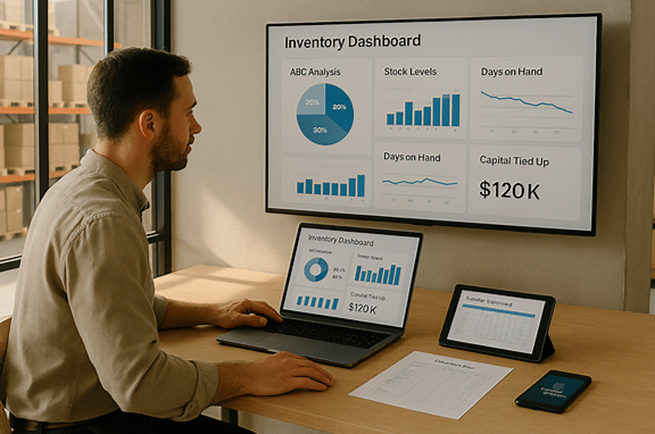

“Inventory is money sitting around in another form.”
— Rhonda Adams
Disclaimer
The guidance in this blog is for general information only and is not a substitute for tailored legal, financial, or tax advice. Always ensure your inventory practices comply with relevant Australian standards, industry regulations, and accounting requirements.
Introduction
Poorly managed inventory can quietly strangle cash flow. Excess stock ties up working capital, increases carrying costs, and risks obsolescence, while stockouts can damage customer trust and sales momentum.
Disciplined inventory optimisation helps you:
Release cash for growth or debt reduction
Reduce waste, storage costs, and write‑offs
Improve service levels and reliability
Whether you’re operating from a Perth Hills warehouse or drop‑shipping nationwide, treating inventory as an investment—not just a necessity—sharpens both your balance sheet and operational agility.
Strategy 1: Align inventory with demand patterns
Demand forecasting: Use historical sales, seasonality, and promotional calendars to predict needs. Incorporate external signals like market trends or supplier lead times.
ABC analysis: Classify inventory by value and velocity. Focus control efforts on ‘A’ items (high value, low volume), monitor ‘B’, and automate re‑orders for ‘C’.
Safety stock: Maintain calculated buffers based on variability of demand and lead time, rather than guesswork.
Lead time reduction: Collaborate with suppliers to shorten delivery cycles, enabling leaner stock levels.
Vendor‑managed inventory (VMI): Where appropriate, shift responsibility for monitoring and replenishment to suppliers.
Lifecycle management: Map items from introduction to decline; actively plan markdowns, bundles, or clearance for slow movers before they become dead stock.
Strategy 2: Improve visibility and control
Integrated systems: Connect sales channels, warehouse management, and accounting in real time. Avoid reliance on manual spreadsheets for critical SKUs.
Batch and serial tracking: Use barcodes or RFID for accurate, fast counts and traceability—critical in regulated industries.
Regular cycle counts: Replace year‑end stocktakes with rolling, focused audits to correct errors early.
Re‑order point automation: System alerts ensure replenishment triggers are consistent and data‑driven.
Multi‑location optimisation: Balance stock between warehouses, stores, or drop‑ship partners to reduce transfers and missed sales.
Supplier scorecards: Track on‑time delivery, order accuracy, and responsiveness to support agile planning.
Strategy 3: Free up capital strategically
Liquidate excess: Use targeted discounts, bundles, or wholesale to turn slow stock into cash.
Consignment arrangements: Pay suppliers after sell‑through to ease upfront capital requirements.
Just‑in‑time (JIT) replenishment: Minimise on‑hand inventory while maintaining service; best for predictable demand and responsive suppliers.
Deferred payment terms: Negotiate longer payment windows aligned to your cash conversion cycle.
Cross‑functional alignment: Finance, operations, and sales must agree on target stock levels and capital allocation priorities.
Continuous improvement: Review KPIs monthly, test adjustments, and lock in gains as processes and relationships mature.
Implementation checklist
Complete ABC analysis and set demand‑based reorder points
Establish safety stock formulas and supplier lead time targets
Integrate inventory, sales, and accounting systems for live data
Roll out cycle counting and automation for replenishment
Create a capital release plan for excess and obsolete stock
Next steps
This week: Run ABC analysis, identify top ‘A’ items, and check current stock vs reorder points.
Within 14 days: Implement cycle counting for one category, integrate sales and inventory data feeds, and negotiate supplier lead time reductions.
Within 30 days: Execute clearance plan for slow movers, lock in revised reorder formulas, and review capital released to redeploy into growth.
Useful AI prompts
“Analyse my past 12 months of sales and suggest ABC inventory classification.”
“Calculate optimal safety stock for these SKUs with given demand and lead time variability.”
“Draft an email to a supplier proposing VMI for my top 10% of SKUs.”
“Suggest liquidation strategies for slow‑moving inventory without damaging brand perception.”
“Model the cash impact of reducing average days‑on‑hand by 10%.”
About Mission Command Business
Mission Command Business equips small enterprises with strategic frameworks and operational tools. From financial management and business direction & support, to people & workplace management, and systems & processes, we help you unlock sustainable growth and lasting impact.