
Leverage digital transformation to accelerate growth
A practical framework for using digital transformation as a growth engine—anchoring technology decisions to business goals, building data driven capability, and embedding continuous improvement into daily operations.
Milton Brooks
11/20/20242 min read
“The greatest danger in times of turbulence is not the turbulence—it is to act with yesterday’s logic.”
— Peter Drucker
Disclaimer
The guidance in this blog is general in nature and should not be taken as tailored technology, financial, or legal advice. Always consult qualified professionals before implementing major digital initiatives, ensuring compliance with data privacy, cybersecurity, and relevant Australian or UK regulations where you operate.
Introduction
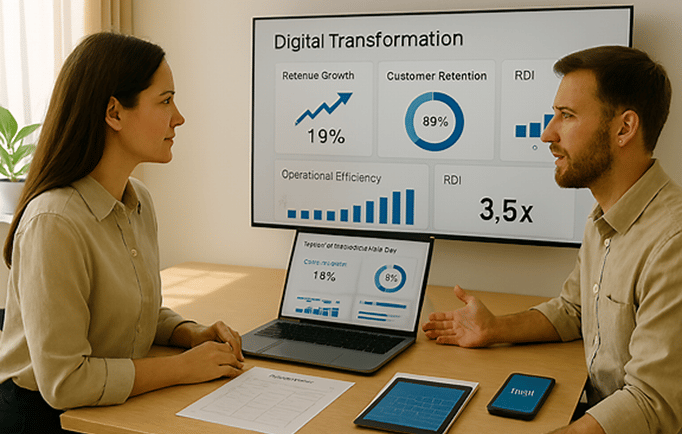
Digital transformation isn’t just about adopting technology—it’s about rethinking how your business creates value, delivers outcomes, and scales sustainably.
Done well, it can:
Unlock new revenue streams and business models
Improve operational efficiency and decision‑making
Deepen customer relationships through personalisation and speed
Build resilience against market volatility
For a Perth‑based SME or a multi‑entity organisation, a strategic, staged approach ensures transformation delivers measurable growth rather than costly disruption.
Strategy 1: Anchor technology to your growth objectives
Vision before tools: Start with a clear business case—what problems are you solving, and how will they translate into ROI?
Prioritise high‑impact areas: Focus on processes or experiences that directly drive revenue, reduce cost, or increase customer loyalty.
Fit‑for‑purpose selection: Choose platforms (ERP, CRM, e‑commerce, analytics) that align with your scale, sector, and integration needs.
Integration over isolation: Ensure new systems connect with existing tech to enable seamless data flow.
Scalable architecture: Opt for cloud‑based or modular solutions to support growth without costly re‑platforming.
Vendor due diligence: Assess financial stability, roadmap, and local support presence.
Strategy 2: Build a data‑driven culture
Single source of truth: Consolidate customer, financial, and operational data into unified dashboards.
Advanced analytics: Use predictive and prescriptive analytics to anticipate trends, optimise pricing, or manage inventory proactively.
Customer insights: Segment audiences for personalised marketing, offers, and service.
Real‑time decision‑making: Shift from static reporting to live metrics for faster pivots.
Data governance: Define ownership, quality standards, and compliance processes (e.g., GDPR, Australian Privacy Act).
Upskill teams: Invest in data literacy so staff can interpret and act on insights.
Strategy 3: Drive adoption and continuous improvement
Leadership sponsorship: Senior leaders must champion change, allocate resources, and reinforce priorities.
Change management: Communicate the “why” and “how” to build buy‑in; address resistance early.
Incremental delivery: Roll out in stages, with quick wins that build momentum and confidence.
User experience focus: Involve end‑users in design and testing to ensure tools fit workflows.
Performance tracking: Define KPIs linked to ROI, such as time saved, conversion uplift, or error reduction.
Feedback loops: Regularly review outcomes and refine configurations, processes, or training.
Implementation checklist
Define business objectives and link them to measurable tech outcomes
Prioritise 2–3 high‑impact areas for initial transformation
Select and vet platforms for fit, scalability, and integration potential
Consolidate data into unified dashboards with governance rules
Create change management plan and adoption KPIs
Next steps
This week: Map pain points and growth opportunities, then shortlist potential digital initiatives.
Within 14 days: Engage stakeholders to define requirements and ROI metrics; start vendor evaluation.
Within 30 days: Launch first transformation sprint—focus on a high‑impact process with measurable benefits, and track adoption closely.
Useful AI prompts
“Create a digital transformation roadmap for a [your industry] SME targeting 20% revenue growth.”
“Compare ERP solutions suited for a Perth‑based company with under 100 employees.”
“Generate a dashboard layout combining sales, customer, and operations KPIs.”
“Draft change management comms to increase adoption of a new CRM platform.”
“Suggest predictive analytics use cases for improving customer retention.”
About Mission Command Business
Mission Command Business equips small enterprises with strategic frameworks and operational tools. From financial management and business direction & support, to people & workplace management, and systems & processes, we help you unlock sustainable growth and lasting impact.